Corrugated sheet purlin spacing in Hungary
Purlin spacing decides whether your roof will be fine for 30 years, or leak in 5. And it also decides how much you spend on the support structure. Too dense = wasted money. Too sparse = the sheet sags. We give exact numbers here, not generalisations.

Work out your material requirement in under a minute!
Free, no obligation - no personal details required
What is a purlin?
The purlin is the horizontal support element in the roof structure on which the corrugated sheet sits directly. Think of a ladder: the rafters (or steel frame) are the two sides of the ladder, and the purlins are the rungs that connect them. The corrugated sheet rests on these "rungs".
Purlins can be wooden battens (5×5 or 6×8 cm), steel Z/C profiles, or hollow sections. They distribute the roof load - sheet weight, snow, wind - evenly and transfer it to the main support.
The purlin spacing is the centre-to-centre distance between two adjacent purlins in centimetres. This is decisive for whether the sheet can bear the load or sags, and whether the roof will stand for a few years or a few decades. That's why it's crucial to calculate the distance correctly. This article is about that.
Why is purlin spacing important?
If the purlins are too far apart, the sheet sags in the middle. Not immediately, not dramatically. At first only a few millimetres - but that's enough for a bit of water to stay after rain. At the next rain, more. Within half a year there's a permanent puddle on the sheet, which starts rust. A seemingly minor defect like this can easily lead to a newly built corrugated sheet roof leaking within a few years.
It always starts the same way: someone wants to save, places the purlins a little further apart than they should, thinks those few centimetres really won't matter - and for the first two years there is no problem, but in the third year the complaint arrives.
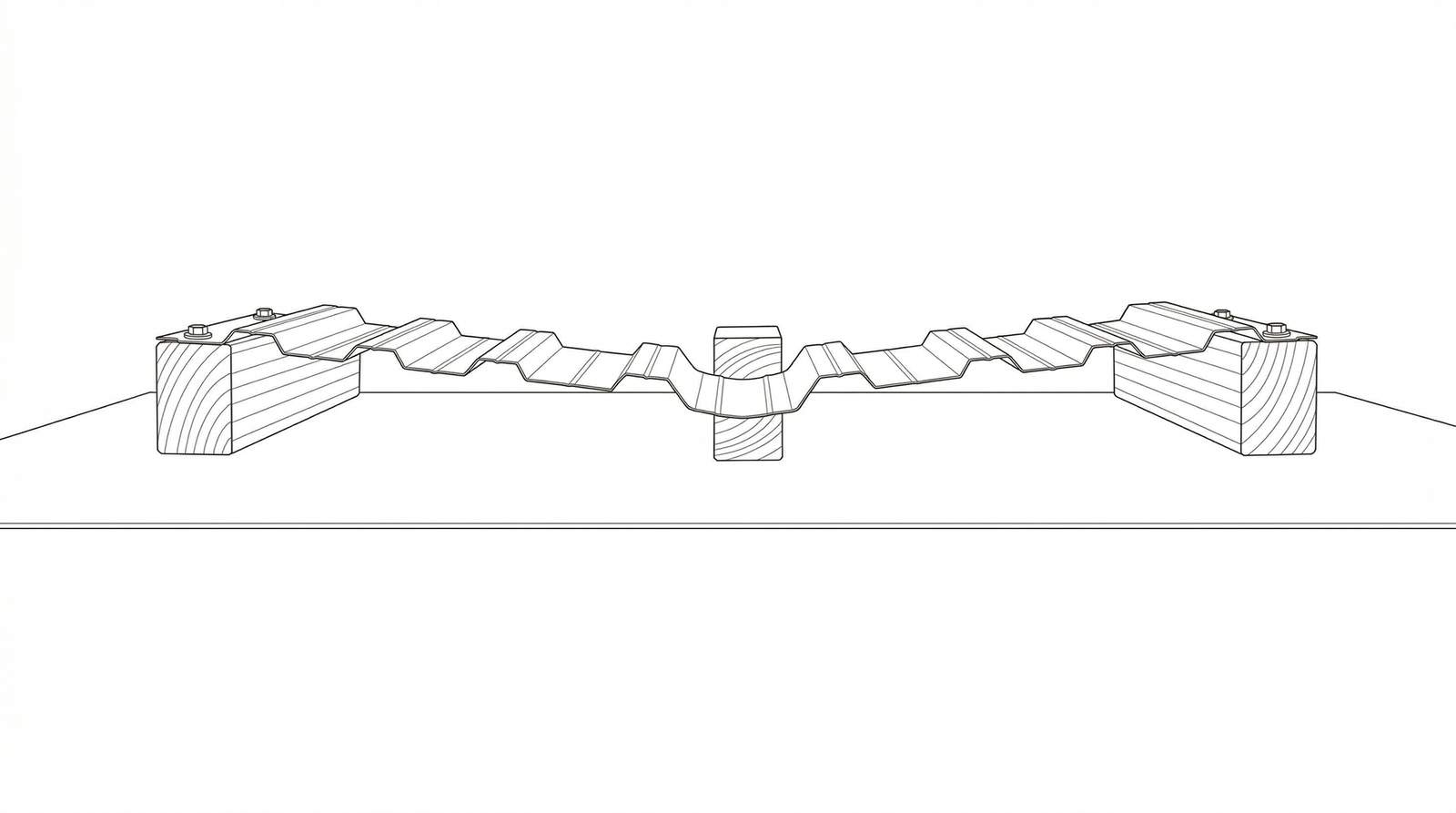
But the other direction isn't optimal either; over-engineering isn't worth it: if you place the purlins too densely, you needlessly spend on material and labour, and the roof won't be any better for it.
How much should the purlin spacing be?
The tables below refer to average Hungarian conditions: snow zone II, normal wind load, 15-30° roof pitch. If you build in a mountain area, stand on exposed terrain or your roof is very flat, take 15-20% off these values and install more purlins.
We don't sell 0.4mm sheet and we don't really recommend it for roofing - we've seen many problematic installations with this or even thinner sheet over the years - but since so many people try to save with weaker material, we included it in the table too. Based on our experience, 0.5mm is what we confidently put our name behind - strong enough not to flex, light enough to work with comfortably. We often stock 0.6mm material too, which we can offer at a very favourable price if the buyer accepts that not every colour is available.
| Profile | 0.4 mm | 0.5 mm | 0.6 mm+ |
|---|---|---|---|
| T8 | 20 cm | - | - |
| T10 | 25 cm | - | - |
| T12 | 30 cm | 40 cm | - |
| T14 | 35 cm | 45 cm | - |
| T18 | 40 cm | 50 cm | 60 cm |
| T20 | 40 cm | 55 cm | 65 cm |
| T25 | - | 65 cm | 75 cm |
| T35 | - | - | 100 cm |
| T40 | - | - | 125 cm |
Maximum purlin spacings by profile and thickness. Plan 10-15% below this.
These are maximums, not target values
The numbers in the table are not the optimal but the still acceptable distances, so we recommend you stay 10-15% below them. If the table says 50 cm, plan 43-45 cm. Safety margin isn't luxury - it's foresight.
Purlin calculator
Enter the sheet type and the conditions - we will calculate the recommended purlin spacing.
How does the calculator work?
The calculation is based on the exact data from the article table. Every profile-thickness pair has a base purlin spacing.
Snow zone: In Zone I the full distance. In Zone II −10%. In Zone III −20%.
Roof pitch: Low pitch −15%. Steep pitch +10%.
Solar: −20% because of the extra load.
The recommended spacing is 90% of the maximum - that is the safety margin.
The calculator is for guidance only. The calculated values are for average Hungarian conditions (Zone II snow, normal wind load). In special cases (mountains, open terrain, solar panels, pitch below 10°) structural sizing is required. The contractor is always responsible for the final decision.
What loads must a roof bear?
Three things load the sheet at the same time, and all three must be considered when planning purlin spacing.
The sheet's own weight
A 0.5mm T18 sheet weighs about 5 kg per m². Add vapour barrier film, insulation, internal cladding - up to 8-15 kg per m² in total. This is a permanent load that's always there.
Snow
Hungary has three snow zones, and it's not just the mountains:
| Snow zone | Load | Where? |
|---|---|---|
| Zone I | ~125 kg/m² | Great Plain, Budapest area |
| Zone II | ~175 kg/m² | Transdanubia, lower parts of Northern Hungary |
| Zone III | ~250 kg/m² | Higher parts of Bükk, Mátra, Bakony |
Snow slides off a steeper roof (above 30°) more easily, so the load is smaller there. But on a 15° roof you must plan for the full snow load.
Wind
Wind causes trouble in two ways. First it presses the sheet down (on the windward side). Second - and more dangerous - it lifts the sheet: this is wind suction, which is strongest at eaves, gables and corners.
That's why denser fixing is needed at the roof edges. Not because we want to sell more screws, but because in the next storm the wind catches the sheet where it is free on the edge.
When do you have to reduce the purlin spacing?
If your building is in a mountain area, stands on open terrain without wind shelter, the roof is flatter than 15°, purlin span exceeds 6 metres, or you plan solar panels on the roof - take 15-20% off the table values and place purlins more densely. These don't all have to apply at once. Even one is enough to justify reducing the distance.
Why does thickness matter so much?
The bending stiffness of sheet metal doesn't grow linearly with thickness; it is approximately proportional to the cube of the thickness. This means even a small thickness increase causes a significant stiffness increase. Actual load-bearing capacity, however, is determined together by the sheet's profile, support and roof design.
What does that mean in numbers?
| Thickness | Relative strength | What it means |
|---|---|---|
| 0.4mm | 100% | Baseline |
| 0.45mm | 142% | Already noticeably stronger |
| 0.5mm | 195% | Nearly twice the strength |
| 0.6mm | 338% | Three times the strength |
| 0.7mm | 536% | Five times the strength |
So a 0.5mm sheet is almost twice as stiff as a 0.4mm one - that's why it's more stable, wavers less and holds up better during installation.
Rib height also matters
The number after the T indicates rib height in millimetres. The higher the rib, the stiffer the sheet. A T18 (18mm rib) is roughly three times as stiff as a T12 at the same thickness.
If you combine both effects: a T18 0.5mm sheet can be up to three times as strong as a T12 0.4mm. The cost differences between types are modest - thicker and higher-profile sheets cost a little more per m², but the savings on purlins and labour usually outweigh that difference.
What purlin to choose, and how to fix it
Keeping the purlin spacing is only half the job. Fixing is at least as important.
Wood, steel or hollow section?

Wooden purlin - typically a 5×5 or 6×8 cm batten. Cheap, easy to work with, and perfectly fine for most house roofs. The point is that it be treated and properly dried, with moisture content max 18-20%. If not, it will warp and mould over time.
Steel Z/C profile - Z140, Z160, C140, C160 sizes. Doesn't warp, precise, durable. But more expensive, and harder to work with on site. For halls, industrial buildings and larger spans we recommend this.
Steel hollow section - 40×60 or 60×80mm. Good value, easy to connect. But lower bending resistance than Z/C. Recommended for garages, sheds and smaller roofs.
How many screws per m²?
Corrugated sheet is fixed with special self-drilling roofing screws with EPDM rubber seals. The number of screws depends on which part of the roof you're on:
| Where? | Screws/m² | Why? |
|---|---|---|
| Middle fields | 6 pcs | Normal load |
| Edge strips (1m along eaves, gable) | 8 pcs | Higher wind suction |
| Corner zones (1×1m at corners) | 10 pcs | Strongest wind suction |

Should screws go in the rib or the valley?
In Hungary, valley screwing is common - the screw goes into the groove and presses the sheet against the support. Good seal, simple. Downside: when the rubber seal ages, water will flow in where the sheet has the screw hole.
Rib screwing has the advantage that water doesn't reach the screw. Downside: the rib may deform under pressure. For most house roofs we recommend valley screwing with a quality EPDM-sealed screw.
Don'ts - the most common mistakes
In 10 years we've seen a lot of roofs. Some have stood 20 years with no problems. Some leaked after 3 years. The difference is almost always the same mistakes.
1. Don't do it just because the neighbour did
The neighbour may have used a different sheet, different pitch, different span. Or they made the same mistake that will show up on their roof in 5 years. Just because something stands doesn't mean it stands well and will still stand next year.
2. Don't exceed the purlin spacing, not even by 10 cm
55 cm instead of 50 - doesn't sound like much. But load grows with the square of distance. So 10% more distance = 21% more load on the sheet. That already eats into the safety margin. We say: if the table says 50 cm, don't go above.
3. There should be a purlin at the roof edge too
The last purlin should be at most 30 cm from the roof edge - at eaves and gables alike. If sheet edges hang freely, in the first serious wind it gets under and lifts the sheet. Fixing this is much more expensive than preventing it.
4. Every distance matters, not just the average
If 9 of 10 purlins are fine but one is further out, the sheet will sag there. The average isn't what counts. Every single spacing must stay within the allowed maximum.
5. The purlin is load-bearing too
A 3×5 cm batten won't bear a 2-metre span. The purlin doesn't just hold the sheet - it holds itself between two main supports. For large spans you need thicker battens or steel profile.
6. Without film, the wooden purlin rots
If there's no vapour barrier under the sheet, condensation forms on the sheet underside and drips onto the wooden purlin. In a few years the wood decays, loses its load-bearing capacity, and you can replace the sheet too. Film costs a few hundred Ft per metre. Purlin replacement costs tens of thousands.
7. Don't skimp on screws
Many think fewer screws mean faster work and cheaper installation. That's true, but in the first serious wind the sheet can tear off, and few things are more frustrating than having to redo the whole roof. We had a customer who wanted to save a box of screws on an 80 m² roof. In the next summer storm three sheets blew away, and the damage including leaks was six figures - which could have been avoided with a few thousand Ft and an extra hour of work.
When to call an engineer?
Our tables and calculators above are indicative. For most garages, sheds and smaller house roofs they can serve as guidance. But there are cases where a professional structural engineer's opinion is always needed:
If the purlin span exceeds 6 metres. If you build in a mountain area (snow zone III). If the building stands on open, exposed terrain without wind shelter. If the roof is flatter than 10°. If you're installing solar panels too. If it's an industrial building.
In such cases it's also worth getting an engineer's opinion just to check we haven't miscounted something. Good design is always the simplest and most effective way to save.
Special cases
Solar panels on the roof
A solar panel weighs 15-25 kg per m². This must be accounted for in purlin spacing - take 20-25% off the table values or use thicker sheet. Also, solar panel brackets may fix to the purlins, so purlin positions must align with bracket positions. This can't be solved afterwards - you have to plan ahead.
Rigid insulation under the sheet
PIR foam boards or similar rigid insulation slightly increase system stiffness, but this does not replace the purlins. What matters: the screw must reach the purlin through the insulation. So thicker insulation needs a longer screw.
Curved corrugated sheet
If the sheet is curved, this means extra stress. Depending on the curve, 70-80% of the flat-surface purlin spacing applies. So if 50 cm would be the max flat, 40 cm max curved.
Where two sheets overlap
At lengthwise sheet joins, the overlap must always be over a purlin. Minimum 15 cm, recommended 20 cm. Don't forget the sealing tape - without it, the overlap won't be watertight. And importantly: if the overlap falls between two purlins, the sheet will sag there for sure, because double thickness means double weight with no support.
Unsure about dimensions? Get a quote!
Free, no obligation - no personal details required
Summary - what to remember from all this
If you remember one thing from this article, let it be this: T18, 0.5mm, 40-60 cm purlin spacing. This combination is the best we can recommend for most Hungarian house roofs. Only deviate from this if you have a good reason - and if you do, you'll find which direction in the table above.

Got the purlin spacing sorted?
Then the next step is installation. We've written a detailed step-by-step guide on that too: Corrugated sheet installation guide
If you have any questions, we're happy to help. We hope your roof will be a joy to look at for a long time - and if you're looking for quality sheet at a favourable price, we recommend ourselves!
Frequently asked questions
How many purlins do I need for a 6-metre roof?
It depends on the sheet you use. T12 0.4mm needs 10 per row, T18 0.5mm needs 6. That's a 4-purlin difference per row - which shows up in material, labour and time. The number of rows is determined by the roof length.
What happens if the purlin spacing is larger than it should be?
At first you don't notice anything. Then after rain, a bit of water stays in the middle of the sheet. A few months later it's a permanent water pocket. This accelerates rusting, and within 3-5 years the roof leaks. We've seen this dozens of times - it always ends the same way.
Wooden or steel purlin - which is better?
For houses, garages and sheds, wood is perfectly fine - provided it's treated and properly dried. For halls, industrial buildings and large spans we recommend steel Z/C profiles because they don't warp and are more precise. Wood is cheaper and easier to work with. Steel is more durable and reliable. Neither is worse; they just belong in different places.
Is T18 always better than T12?
For a roof, yes, almost without exception. T12 is weaker, needs more purlins under it, and if you add up the total cost you usually end up paying more with it. T12 has its place where there is no real load: facade cladding, shed walls, fences.
How much can a T18 0.5mm sheet hold?
Under normal conditions - say western Hungary, 20-25° roof pitch - with 40-60 cm purlin spacing it easily takes what comes. That's about 150-180 kg per m² when you add up snow, wind and self-weight. That's enough for the average Hungarian house roof.
How do I calculate the number of purlins needed?
Simple: divide the roof width by the purlin spacing and add one. Example: a 6-metre roof, T18 0.5mm sheet, 50 cm purlin spacing: 6 divided by 0.5 plus 1 = 7 purlins per row.
Does roof pitch matter for purlin spacing?
Not directly, but indirectly yes. Snow slides off a steeper roof more easily, so the load is smaller. But our table is calculated for 15-30° pitch, which covers most Hungarian roofs. On a very flat roof you need to reduce the spacing.
Can I use mixed purlin spacing on one roof?
Yes, and sometimes it's explicitly worth it. At the roof edges - eaves, gables - smaller spacing is needed because of higher wind load. The middle can have the normal spacing. This is not botching, it's conscious design.
How much do overlaps load the purlins?
Where two sheets overlap, there is double thickness, which means extra load. That's why the overlap must always be over a purlin. If it falls between two purlins, the sheet will certainly sag there. You can't get around this.
What to do if it turns out later that there aren't enough purlins?
You have to take the sheet off - partially or fully - install the new purlins, then put everything back. Complicated, slow and expensive. We had a customer whose later addition cost more than they originally saved on the whole support structure. It's cheaper to prevent this mistake.